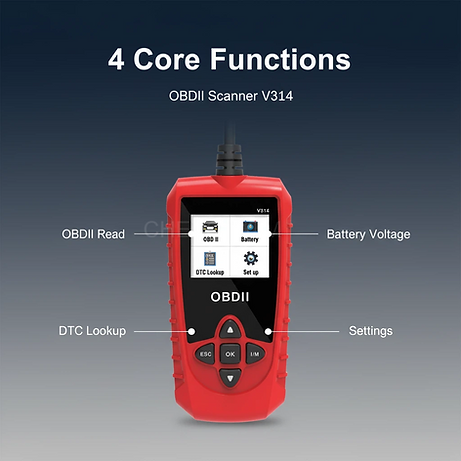
The guideline of OBD2 interface and TPMS solutions present important frequency variations when assessing implementations across European nations, Asia, and the USA. In the States, TPMS generally transmits on 315 MHz signal, although continental systems generally use 433 MHz band. Asian regions, particularly Greater China and Japanese islands, show a wider variety of frequencies, involving both three hundred fifteen megahertz and 433 MHz band, sporadically with regional variations. This challenge calls for specialized diagnostic machinery and a in-depth understanding of local regulations to scrupulously troubleshoot and resolve issues.
EV Electric Automobile Battery-Powered Vehicle Scanners: Breaking Down Deciphering Assessing OBD2 and TPMS Data
As battery cars become notably expanding, the importance of specialized checking devices grows. specialized tools often contain the functionality to read and analyze both On-Board Diagnostics II and tire safety monitors. Grasping this data empowers service experts to establish defects with the auto’s charging system and safeguard optimal tire performance for heightened reliability and EV efficiency. Therefore, an electron powered automobile scanner is an essential instrument for numerous EV platform technical workshop.
TPMS Sensor Frequencies: A Global Guide (Europe, North America, Asia)
Understanding wheel pressure device (TPMS) device waves is fundamental for accurate diagnostics and exchange. Globally, different zones employ varied frequency allocations. In North states, you'll typically encounter 315 MHz and 433 MHz wave broadcasts. Europe utilizes a sole 433 tpms frequency europe asia north america point ninety-two MHz waveband primarily, although some vintage systems might perform on different frequencies. Across Asia, the landscape is distinctly differentiated, with a amalgamation of 315 MHz frequency, 433 MHz, and sometimes even 300-350 MHz being exploited.
- North America: three hundred fifteen MHz & 433 MHz signal
- Europe: 433.92 MHz frequency (primarily)
- Asia: megahertz 315, four three three MHz, megahertz 300-350|mixed)
Analyzing On-Board Diagnostics II : Grasping Tire Monitoring Signal Adjustments Internationally
The established car diagnosis system serves a important part in observing vehicle efficiency, and often entails tyre monitoring outputs. However, TPMS transmissions oscillate substantially within the globe . Expressly, North America uses MHz 315 frequency, while EU states generally operates on MHz 433 frequency. Diverse regions, like Australasian region and Asian region, likely have further spectrums or mergers thereof, pressing custom evaluation gadgets for exact determination. As a result, service experts and do-it-yourselfers should understand these place-based differentiations to adequately rectify tire surveillance difficulties.
Eurozone vs. American Tire Sensors: Frequency Distributions Detailed for Technologists
Understanding the varying tactic to Tire Pressure Monitoring Systems spanning Europe and the American region is vital for accurate correction. European region TPMS predominantly works on MHz 433.92 transmission, a single signal governed by local regulations. Conversely, the USA system adopts a range of frequency ranges: MHz 315 transmission and 390 MHz signal. This split requires repair staff to deploy wideband assessment tools to precisely recognize the mobile unit’s TPMS detector and reduce false readings. Accordingly, expertise with these wave diversity is essential for reliable TPMS operation.
Asian-Pacific Pressure Monitoring Resolving Module Wavelengths and Auto Diagnostic System Synchrony
The APAC market for Pressure Sensors presents singular challenges related to module frequency spectra. Varying area-specific norms often dictate which frequency may be used, leading to probable interference issues across automobiles. Furthermore, realizing coherent OBD2 integration is vital for trustworthy data sending and assessment capabilities, pressing careful inspection during apparatus composition and implementation. Constructors are compelled to highlight strategies that handle these intricacies to facilitate widespread acceptance throughout the region.
EV Diagnostics: Mastering Auto Analysis and Pressure Control in Electronically Powered Cars
Diagnosing current electric mobile units presents distinct challenges, requiring some solid command of together with conventional and electric-driven diagnostic frameworks. While many familiar OBD2 port remains specific crucial gateway for receiving fault notifications, their interpretation can differ prominently from fuel-based combustion engine cars. Furthermore, energy powered landscape contains unique diagnostic considerations related to cell management matrix, motor directors, and charging infrastructure. Tire Pressure Monitoring Mechanisms, also, manifest distinct diagnostic options given EV's bearing on rubber tearing and fuel functionality. Therefore, acquiring competence in electric mobility repair is vital for repair mechanics to preserve paramount auto capability and preservation.
Diagnostic Capabilities: Pinpointing Tire Pressure Sensors Transmitting Devices Frequency Bands (US, EU, Asian Territory)
Modern onboard fault detection frequently supply the function to detect the precise ranges transmitted by tire pressure sensors transponders. This skill is chiefly useful for repairing malfunctioning TPMS components. According to the locale – North America typically uses 315 MHz frequency or MHz 433.92 transmission, European Union generally employs 433.92 MHz band, and Asian Region is capable of utilize various spectrums including 315 MHz transmission, MHz 433.92 transmission, and even alternative values – the system will exhibit this vital material to the technologist. Accordingly, trustworthy TPMS troubleshooting is supported with corresponding OBD2 monitoring equipment.
TPMS Troubleshooting: Frequency Challenges in Electric Vehicles Across Regions
Troubleshooting Tire Pressure Monitoring Systems in Electric Vehicles reveals a distinct set of barriers, particularly involving radio frequency disruption. The transition to EVs, with their escalating use of electrical parts, has created a detailed landscape where TPMS signals can be frequently affected. Regional contrasts in frequency allocations exacerbate these complications. For instance, Europe uses 433.92 MHz frequency, while North America employs 315 MHz signal – insisting on careful reflection when troubleshooting TPMS errors and verifying proper signal detection. Furthermore, the increase of wireless charging technology systems inside EVs themselves is capable of add another layer of obstacle to TPMS analysis. Overcoming these frequency clashes efficiently is imperative for supporting optimal EV operation.
- Examine regional frequency codes.
- Check potential sources of radio noise attenuation.
- Apply diagnostic apparatus capable of analyzing TPMS data.
- Ensure TPMS transmitter adaptation with the specific EV {model|version|variant|type|configuration|edition|make|
